Refrigerant costs and 2026 rules: verify applicability before budgeting
Use EPA resources to separate technician certification, Section 608 and newer HFC requirements before assigning refrigerant work and records.
Identify the refrigerant and appliance first
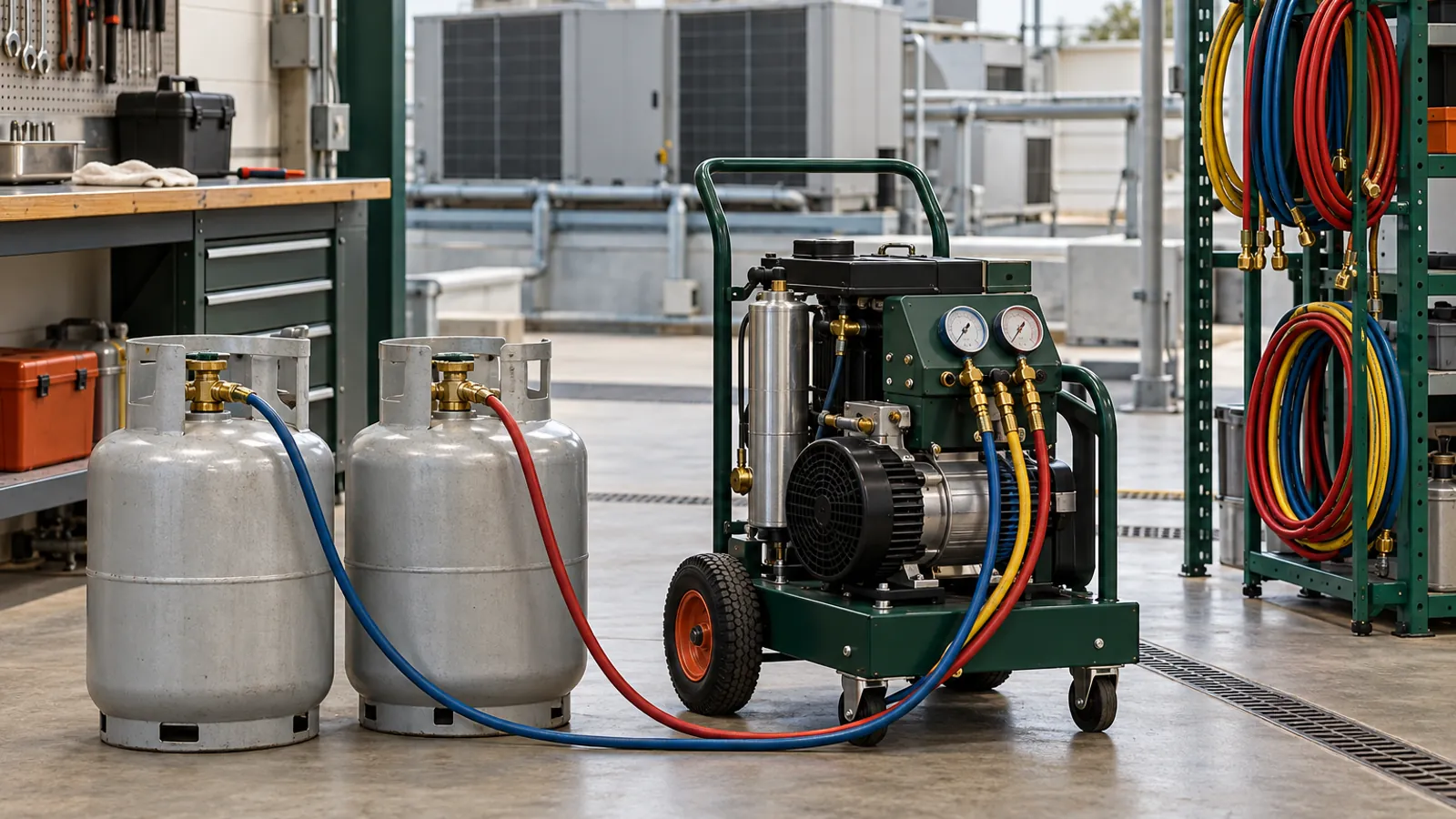
Budget refrigerant work only after identifying the appliance, refrigerant, charge information and proposed task. Federal requirements are not determined by the word commercial alone. Section 608 and the newer HFC management framework must be checked separately for the actual equipment. This guide deliberately does not present one leak threshold as applicable to every commercial air-conditioning system.
Use the asset record, manufacturer information and qualified technician’s assessment to resolve missing data. Do not guess refrigerant type from age, cabinet appearance or a neighboring unit. The owner should know who is responsible for retaining the equipment and service records and who will check the current requirements.
Certification and business licensing are different checks
EPA’s current Section 608 technician questions explain that certification is required for work that could breach the refrigerant circuit and release refrigerant. The certification type must fit the work. Ask the contractor how the assigned personnel meet the applicable requirement. This does not establish that the contractor has every state or local business license or is qualified for every equipment task.
Check local requirements through the relevant jurisdiction and request the contractual insurance and qualifications needed for your procurement. Avoid using a certification logo as a substitute for a task-specific competence review. This guide is not a legal determination of eligibility to perform a particular job.
Read the newer framework alongside Section 608
EPA publishes a January 2026 fact sheet comparing leak-repair requirements for HFCs and certain substitutes with the Section 608 framework. The fact sheet identifies different applicability and exemptions. Do not infer from an older statement about substitute refrigerants under Section 608 that no other federal refrigerant management obligation can apply.
Open the current EPA materials and the underlying regulations with your compliance adviser. Record the appliance category, refrigerant and the reason a provision is applicable or exempt. Keep the conclusion and source date with the equipment record. A general web article cannot determine compliance for an unidentified appliance or resolve all subsequent regulatory changes.
Price diagnosis, repair and refrigerant separately
Request a written scope that distinguishes locating a leak, performing repair, any required tests, recovery, refrigerant supply and documentation. Adding refrigerant and resolving the underlying cause are different commercial tasks. Ask what evidence supports the proposed remedy and what happens if additional work is discovered.
Illustrative example only: a hypothetical quote lists $300 for diagnosis, $700 for repair and $400 for materials and refrigerant, totaling $1,400. These invented figures are not market prices and do not imply that this scope is technically sufficient. The contractor must define the actual work and applicable records. Do not use the example to authorize field procedures.
Assign the records before work starts
| Record question | Responsible party to name |
|---|---|
| Appliance identification and refrigerant | Owner and qualified service team |
| Applicability decision | Owner with compliance support |
| Work and refrigerant quantities | Service contractor |
| Required tests and follow-up | Party named in the service scope |
| Retention and reporting | Owner’s designated record custodian |
Ask for asset-specific records rather than a site-wide line saying refrigerant added. Where a requirement does not apply, retain the reason instead of leaving a blank. A contractual assignment helps organize work, but it does not automatically transfer every legal obligation away from an owner or operator.
Keep the review boundary visible
The EPA resources linked below were accessed during this implementation on October 30, 2026. That access is a source check, not a legal opinion or a claim that a qualified professional reviewed your equipment. Confirm the current rule text before acting, particularly where a compliance deadline or exemption matters.
Set a follow-up action for any unresolved applicability question. If the contractor proposes a replacement refrigerant or system modification, obtain equipment-specific technical and regulatory advice. This site does not approve refrigerant substitutions, charge amounts or repair methods. Budgeting should support compliant work rather than encourage repeated top-ups without an identified cause and appropriate documentation.
Keep the allowance separate from the applicability decision
An owner may choose a provisional allowance while a regulatory question is being resolved. Label it provisional and identify the missing information. The presence of money in a budget does not establish that a task is required, permitted or technically sufficient. Likewise, an unresolved budget must not be presented as an exemption from an applicable obligation.
FAQ
Does every commercial unit face the same leak rules?
No. Identify the appliance and refrigerant and check the applicable framework and exemptions.
Does Section 608 certification replace local licensing?
No. Treat federal technician certification and jurisdiction-specific requirements as separate checks.
Can an old Section 608 article settle current HFC requirements?
No. Review the current EPA HFC management materials as well as Section 608 and the underlying rules.
Related decisions
- Commercial HVAC maintenance costs: build a defensible annual budget
- Why two HVAC maintenance quotes can be far apart
- What a commercial HVAC maintenance contract should spell out
- Budgeting maintenance for a fleet of rooftop units
- Filters and consumables: stop double-counting the small costs
- How to set an HVAC repair reserve without pretending to predict failures
- Compare service arrangements
- Use the related planning tool
Sources and limits
- ENERGY STAR — Operation and Maintenance Best Practices — operating schedules, documentation and performance tracking; not price data.
- US EPA — Section 608 technician questions — certification and refrigerant-service responsibilities; verify the actual task.
- US EPA — 2026 leak-repair fact sheet — separate applicability of HFC and Section 608 frameworks.
- National laboratory — Rooftop Unit Maintenance Guide — publication record and technical rooftop maintenance context.
Source links were checked during this implementation on October 30, 2026. Dollar examples are original illustrative arithmetic, not official prices. This guide is general planning information; building-specific technical, safety and compliance decisions require qualified review.