Repair or replace commercial HVAC: organize the decision first
Compare a defined repair and installed replacement scope using condition, continuity, warranties and transparent planning assumptions.
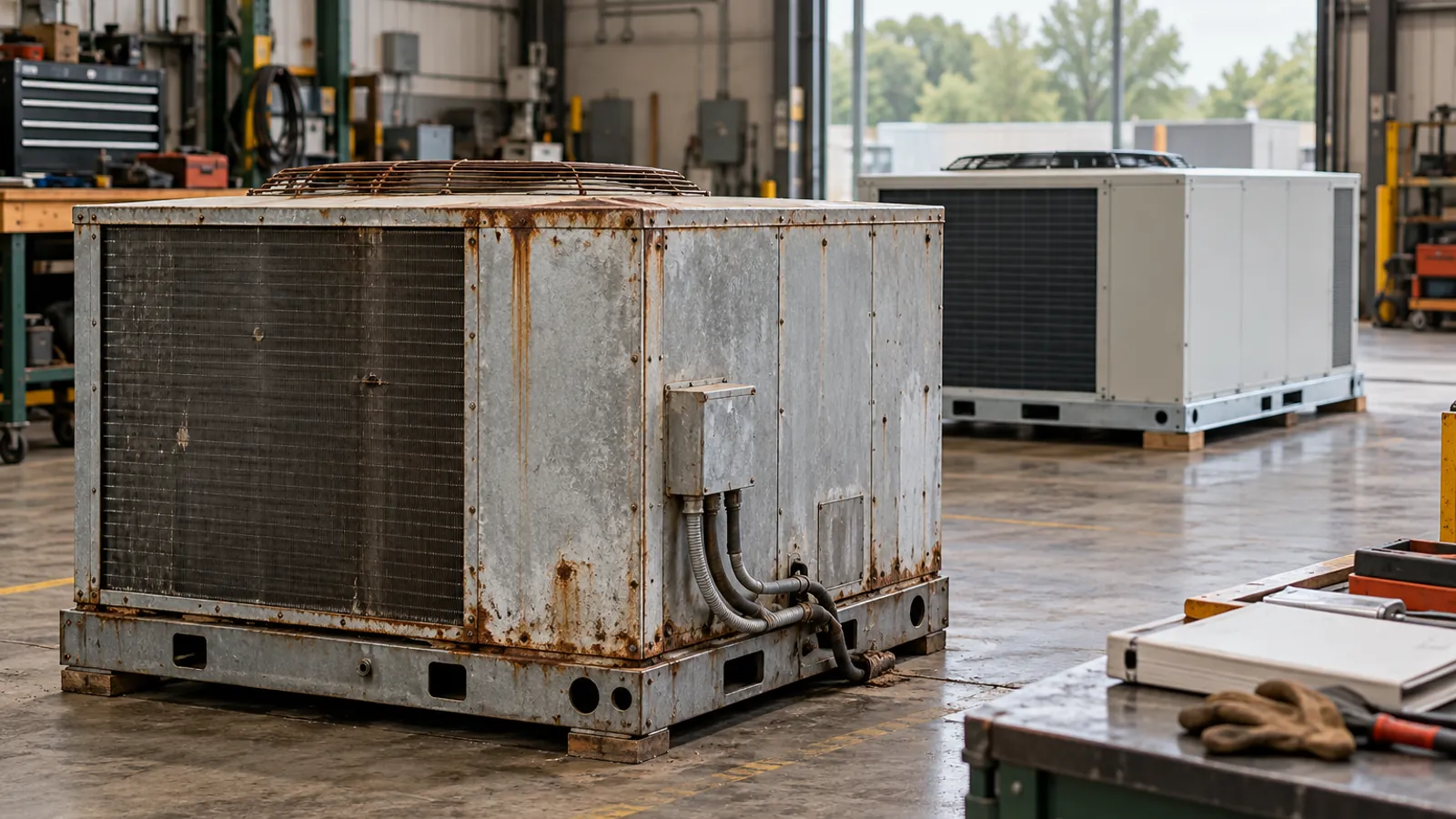
Compare two real scopes, not age against price
A repair-or-replace decision needs an equipment-specific diagnosis and a complete replacement scope. Age alone does not establish the better option. Start by asking what failed, what the proposed repair resolves and what uncertainty remains. Then compare that with a replacement proposal that includes installation, access, controls integration and commissioning.
This site does not provide a universal replacement threshold or a fixed percentage rule. The appropriate decision depends on condition, service needs, risk and the owner’s priorities. Use a qualified technical assessment and involve finance or legal advisers where the contract or accounting consequences are material.
Define the repair outcome
Ask the contractor to describe the fault, evidence, proposed action and expected acceptance test. Identify related defects that are excluded. A repair that restores one component may not resolve a separate controls or distribution problem. Keep diagnosis distinct from assumptions about future reliability.
Record parts availability, warranty terms and the proposed shutdown. Ask what happens if the diagnosis changes after work begins. Set an authorization process for additional work. A repair estimate should not be treated as a promise of remaining equipment life unless a specific supported commitment is written into the offer.
Build the installed replacement scope
A replacement quote should identify the equipment and everything needed to place it into service. Ask about removal, lifting, roof or curb work, electrical or fuel connections, controls, permits where applicable and commissioning deliverables. Confirm which parties are responsible for each interface.
Do not compare a complete repair estimate with an equipment-only purchase price. The missing installation scope can dominate the uncertainty. Likewise, do not assume the new unit will solve an existing building control problem without investigation. Request the design and selection basis from the qualified team and keep the operational requirements visible.
Separate cash cost from operating assumptions
Illustrative example only: a repair is $4,000 and a fully defined replacement is $18,000. The upfront difference is $14,000. If a hypothetical replacement case assumes $1,400 annual net operating savings, the simple difference divided by savings is ten years. Those invented numbers are not market prices, a useful-life estimate or a recommendation.
The calculation excludes discounting, future failures, taxes and residual value. Do not present it as a full lifecycle analysis. Test lower savings and additional recurring costs. If savings cannot be supported by equipment and operating evidence, leave them unresolved instead of using a convenient percentage to justify the preferred choice.
Document non-price decision criteria
| Criterion | Evidence to request |
|---|---|
| Repair adequacy | Diagnosis and acceptance test |
| Replacement completeness | Installed scope and interface list |
| Continuity | Shutdown and temporary-service plan |
| Operating effect | Baseline and supported assumptions |
| Warranty | Written coverage and exclusions |
| Uncertainty | Open questions and responsible reviewer |
A critical served space may make continuity more important than a simple payback number. Record how that priority affects the decision. Avoid inventing a dollar value for downtime unless the business has a documented basis and agrees to use it.
Write the approval conditions
State which option is selected, why and what must be confirmed before work starts. Keep technical approval separate from purchasing authorization. Record any assumptions about access, utility interruption and tenant coordination.
After completion, retain the repair test results or replacement commissioning records and update the asset register. Remove retired equipment from the maintenance agreement and review the new service and warranty requirements. A decision is not finished when the purchase order is issued; the documentation must reach the staff who operate the building and the person who prepares the next annual budget.
Check the decision after completion
Set a handover requirement before authorizing either option. For a repair, retain the diagnosis, work performed and the agreed test result. For replacement, obtain the installed asset details, commissioning records, operating documentation and warranty information specified in the scope. The facility needs those records to maintain the result and challenge an unresolved issue.
Compare the actual final cost with the approved scope and identify authorized variations. If a proposed operating saving was part of the decision, preserve the baseline and assign a follow-up review rather than assuming the saving began automatically on installation day. After final acceptance, update the maintenance agreement to remove retired equipment and include the replacement under an appropriate program. This closes the connection between the capital decision and the next operating budget.
FAQ
Is there a fixed age when replacement is mandatory?
No universal age rule is provided here. Use condition, requirements and qualified assessment.
Can I use a simple payback alone?
It is one screening measure. It does not capture every risk, cash flow or operational requirement.
What if the replacement quote excludes installation?
Obtain a complete installed scope before comparing it with a repair estimate.
Related decisions
- How to compare commercial HVAC service bids on equal terms
- Write an HVAC maintenance RFQ that gets usable answers
- Annual HVAC maintenance budget: a worked six-unit example
- How often should commercial HVAC be serviced? Start with the task
- Test an HVAC improvement payback without assuming savings
- Emergency HVAC service terms: response is not restoration
- Compare service arrangements
- Use the related planning tool
Sources and limits
- ENERGY STAR — Operation and Maintenance Best Practices — operating schedules, documentation and performance tracking; not price data.
Source links were checked during this implementation on October 30, 2026. Dollar examples are original illustrative arithmetic, not official prices. This guide is general planning information; building-specific technical, safety and compliance decisions require qualified review.